Friday, July 24, 2015
Media & Ecology Learning Case Draft
https://docs.google.com/document/d/17bhBqNtKTMIwt1u62JoLBFHpOD-D7K3dLyPhQm6L60Y/edit?usp=sharing

Changing Literacies; Changing Pedagogies
Chapter 7:
"These findings clearly have implications for teacher educators who must find ways of encouraging pre-service teachers to evaluate current practices surrounding digital technology in the classroom."
I found this entire chapter interesting, as I hadn't entirely noticed it before, but the ways that I most usually teach are adaptations of what I used while student teaching. I felt that I learned the most I have ever learned in my life during my student teaching experience. I also feel that while student teaching, the methods that you learn to use then are going to be most comfortable for you to then take to your teaching after graduation.
Chapter 8:
"There is no doubt that in the context of schooling, critical examination of relationships, knowledge and practices are vital (Comber and Simpson, 2001) and, in relation to digital literacies, this is very often associated with issues of access to or exclusion from resources, including hardware, software and connectivity to the internet (Nixon, 2001)"
I liked this quote because I feel that critical examination of relationships is necessary for mastery skill level of any given content. Any content in general education requires the use of making connections and it is often a skill that students can struggle with. I also appreciated the fact that it noted the problems that can arise from lack of access to resources, which is usually technological.
Chapter 9:
"A common stance that lies somewhere between resistance and replacement may be described as ‘return’. By return I mean to indicate a stance that values new literacy practices but validates and defends them with respect to print."
I chose this quote from Chapter 9 because I feel that it reflects my stance on incorporating old media with new media. I feel that we cannot really have new media without the old, and that often times new media is just another way of representing what was already in print. I also believe that in order to truly utilize new media, we must have traditional skills.
References:
Carrington, Professor Victoria; Robinson, Professor Muriel (2012-06-30). Digital Literacies: Social Learning and Classroom Practices (Published in association with the UKLA) (Kindle Locations 2701-2702, 2966-2968, 3124-3125). SAGE Publications. Kindle Edition.
"These findings clearly have implications for teacher educators who must find ways of encouraging pre-service teachers to evaluate current practices surrounding digital technology in the classroom."
I found this entire chapter interesting, as I hadn't entirely noticed it before, but the ways that I most usually teach are adaptations of what I used while student teaching. I felt that I learned the most I have ever learned in my life during my student teaching experience. I also feel that while student teaching, the methods that you learn to use then are going to be most comfortable for you to then take to your teaching after graduation.
Chapter 8:
"There is no doubt that in the context of schooling, critical examination of relationships, knowledge and practices are vital (Comber and Simpson, 2001) and, in relation to digital literacies, this is very often associated with issues of access to or exclusion from resources, including hardware, software and connectivity to the internet (Nixon, 2001)"
I liked this quote because I feel that critical examination of relationships is necessary for mastery skill level of any given content. Any content in general education requires the use of making connections and it is often a skill that students can struggle with. I also appreciated the fact that it noted the problems that can arise from lack of access to resources, which is usually technological.
Chapter 9:
"A common stance that lies somewhere between resistance and replacement may be described as ‘return’. By return I mean to indicate a stance that values new literacy practices but validates and defends them with respect to print."
I chose this quote from Chapter 9 because I feel that it reflects my stance on incorporating old media with new media. I feel that we cannot really have new media without the old, and that often times new media is just another way of representing what was already in print. I also believe that in order to truly utilize new media, we must have traditional skills.
References:
Carrington, Professor Victoria; Robinson, Professor Muriel (2012-06-30). Digital Literacies: Social Learning and Classroom Practices (Published in association with the UKLA) (Kindle Locations 2701-2702, 2966-2968, 3124-3125). SAGE Publications. Kindle Edition.
Sunday, July 19, 2015
Changing Literacies
Chapter 4:
"The printing press heralded an information revolution that drew from and enabled other social, cultural and political change. It was a technology of its time. A growing segment of the public were able to access information in volumes and types never previously imagined, challenging the traditional authority of the church and scholars."
I chose the above quote from Chapter 4 because it draws parallels between the technology of the printing press and the emerging technologies that we are experiencing now, and how it is challenging to adapt to these new modes of learning. At the time when the printing press was invented, it was very advanced and opened an entirely new world of literacy to the public. Just as this happened with the printing press, it is happening to our society now: we are continually being introduced to new and innovative technologies. How we choose to adapt and accept the new ways of learning is what is important.
Chapter 5:
"We now realize that to read online texts in a critical way, one needs to see them as more than free-standing, isolated constructs to be deciphered in the same way as paper-based texts (Penrod, 2007; Richardson, 2006). Blogs need to be read and understood as part of a whole wider network of texts whose process of publishing makes a difference to the way they mean and the role they play in society (Lankshear and Knobel, 2006a)."
I found this quote to be very interesting because it is often difficult to be a critical reader if you do not look at the larger picture of where the information has come from. Information, especially on the internet, comes from so many different informational outlets that it can be very extensive and cover many different perspectives. I also connected with what they mentioned about reading blogs, and understanding that blogs are part of a large network of texts almost working together. I found this to be very important because just as in this class, my blog is only one point of view based on a common text that we are all reading, and reading critically at that.
Chapter 6:
"The idea that digital technology might help to motivate reluctant learners and provide more meaningful contexts for literacy has captured the attention of an increasing number of educators (Merchant, 2007b)."
I really enjoyed this quote because I think it is very important to engage at-risk learners as much as possible. At this day in age I feel like students really have a comfort zone with technology. They are comfortable navigating, creating, and constructing on the internet, which enables them to learn. I have always felt that being comfortable in the classroom was a necessity for learning, and if the technology makes these students feel like they are doing something that they are good at and comfortable with when they're using technology, they are more likely to succeed.
References:
Carrington, Professor Victoria; Robinson, Professor Muriel (2012-06-30). Digital Literacies: Social Learning and Classroom Practices (Published in association with the UKLA) (Kindle Locations 1481-1483, 1811-1814, 2073-2074). SAGE Publications. Kindle Edition.
"The printing press heralded an information revolution that drew from and enabled other social, cultural and political change. It was a technology of its time. A growing segment of the public were able to access information in volumes and types never previously imagined, challenging the traditional authority of the church and scholars."
I chose the above quote from Chapter 4 because it draws parallels between the technology of the printing press and the emerging technologies that we are experiencing now, and how it is challenging to adapt to these new modes of learning. At the time when the printing press was invented, it was very advanced and opened an entirely new world of literacy to the public. Just as this happened with the printing press, it is happening to our society now: we are continually being introduced to new and innovative technologies. How we choose to adapt and accept the new ways of learning is what is important.
Chapter 5:
"We now realize that to read online texts in a critical way, one needs to see them as more than free-standing, isolated constructs to be deciphered in the same way as paper-based texts (Penrod, 2007; Richardson, 2006). Blogs need to be read and understood as part of a whole wider network of texts whose process of publishing makes a difference to the way they mean and the role they play in society (Lankshear and Knobel, 2006a)."
I found this quote to be very interesting because it is often difficult to be a critical reader if you do not look at the larger picture of where the information has come from. Information, especially on the internet, comes from so many different informational outlets that it can be very extensive and cover many different perspectives. I also connected with what they mentioned about reading blogs, and understanding that blogs are part of a large network of texts almost working together. I found this to be very important because just as in this class, my blog is only one point of view based on a common text that we are all reading, and reading critically at that.
Chapter 6:
"The idea that digital technology might help to motivate reluctant learners and provide more meaningful contexts for literacy has captured the attention of an increasing number of educators (Merchant, 2007b)."
I really enjoyed this quote because I think it is very important to engage at-risk learners as much as possible. At this day in age I feel like students really have a comfort zone with technology. They are comfortable navigating, creating, and constructing on the internet, which enables them to learn. I have always felt that being comfortable in the classroom was a necessity for learning, and if the technology makes these students feel like they are doing something that they are good at and comfortable with when they're using technology, they are more likely to succeed.
References:
Carrington, Professor Victoria; Robinson, Professor Muriel (2012-06-30). Digital Literacies: Social Learning and Classroom Practices (Published in association with the UKLA) (Kindle Locations 1481-1483, 1811-1814, 2073-2074). SAGE Publications. Kindle Edition.
Monday, July 13, 2015
Analyzing the Interview
Hanging Out:
The subject of my interview uses technologies to communicate with friends through text messaging and the use of social media outlets such as instagram.
Messing Around:
My young person's biggest interest and the thing that she cited as the most fun on the computer was looking up OneDirection things. She is also going to their concert and found this information on the internet.
Geeking Out:
During the interview she talks of how she uses the computer at school, which she said was mainly for research and typing papers. She said that she also likes to find and play games on the internet.
Schooling:
We did not talk about using technology to read books but we did talk about the use of the computer in school for research. She said that she traditionally uses Google for her research.
The subject of my interview uses technologies to communicate with friends through text messaging and the use of social media outlets such as instagram.
Messing Around:
My young person's biggest interest and the thing that she cited as the most fun on the computer was looking up OneDirection things. She is also going to their concert and found this information on the internet.
Geeking Out:
During the interview she talks of how she uses the computer at school, which she said was mainly for research and typing papers. She said that she also likes to find and play games on the internet.
Schooling:
We did not talk about using technology to read books but we did talk about the use of the computer in school for research. She said that she traditionally uses Google for her research.
Thursday, July 9, 2015
Interview with a Digital Native
Some quotes from our course texts that I am considering including in my final case report that I feel relate to my findings in my interview are listed below:
From Chapter 3 of Digital Literacies: Social Learning and Classroom Practices: "Accordingly, they have developed the capacity to be literate in this digital textual landscape, as well as within their educational settings. Therefore, in addition to their measured educational literacy, Clare and Tom can also be regarded as children who are digitally literate."
From Chapter 8 of Deconstructing Digital Natives: Young People, Technology and the New Literacies: "...how the Internet and the many digital tools available on the Web have affected the way students seek and gather information in the context of higher education."
From Chapter 1 of Deconstructing Digital Natives: Young People, Technology and the New Literacies: "...digital natives are problem-solvers; they have new expectations; they invent new processes; they don't only work for an organization, they think of work as play; they are enthusiastic and skillful."
Wednesday, July 8, 2015
Digital Texts In and Out of School
Chapter 1:
"Although digital technologies may be enabling modes of learning such as trial and error, it is important to look at other modes of learning in relation to these technologies."
I chose this quote from chapter 1 because I think that trial and error is often a great learning tool that students to not realize that they use so much. They do use this so much in learning technology, because they're teaching themselves, and I think that they need to understand that making mistakes is okay. Often in math, students think they need to always get the answer correct, even when first learning the skill set. I encourage students to just try the problem - without help - and if they get it wrong, that is great, because they will then learn from their mistakes. Although this is my biggest agreement with the quote, I also agree that other modes of learning should be utilized as well.
Chapter 2:
"This incident illustrates a number of points; while all of us were involved in an activity that could undoubtedly be described as ‘play’, it was also one which could not have taken place without having acquired a range of complex social and literacy skills beforehand."
The above quote from Chapter 2 summarizes much of what I love about using the digital world as a learning tool. Although the activity at hand was disguised as "play" there is still so much learning going on. I have touched on this subject in previous posts, where I have talked about how although Twitter is a social media outlet, there are limitless learning opportunities via News Outlets' Twitter accounts, which often post much sooner than you may come across them on another site. I also like that it emphasizes the need for traditional learning skills before you may fully use the activity. Using digital media as a learning tool does not replace traditional skills, it simply adds to the skill set of that individual.
Chatper 3:
"Accordingly, they have developed the capacity to be literate in this digital textual landscape, as well as within their educational settings. Therefore, in addition to their measured educational literacy, Clare and Tom can also be regarded as children who are digitally literate."
I chose this quote from Chapter 3 because it draws from the idea that what makes children able to be digitally literate is their success in their educational settings. Students still need their traditional skills that they learn in formal schooling in order to be successful on the tools that they encounter on the internet. Digital literacy is an additional skill that today's students are learning, not a replacement of the traditional formal learning skill sets.
"Although digital technologies may be enabling modes of learning such as trial and error, it is important to look at other modes of learning in relation to these technologies."
I chose this quote from chapter 1 because I think that trial and error is often a great learning tool that students to not realize that they use so much. They do use this so much in learning technology, because they're teaching themselves, and I think that they need to understand that making mistakes is okay. Often in math, students think they need to always get the answer correct, even when first learning the skill set. I encourage students to just try the problem - without help - and if they get it wrong, that is great, because they will then learn from their mistakes. Although this is my biggest agreement with the quote, I also agree that other modes of learning should be utilized as well.
Chapter 2:
"This incident illustrates a number of points; while all of us were involved in an activity that could undoubtedly be described as ‘play’, it was also one which could not have taken place without having acquired a range of complex social and literacy skills beforehand."
The above quote from Chapter 2 summarizes much of what I love about using the digital world as a learning tool. Although the activity at hand was disguised as "play" there is still so much learning going on. I have touched on this subject in previous posts, where I have talked about how although Twitter is a social media outlet, there are limitless learning opportunities via News Outlets' Twitter accounts, which often post much sooner than you may come across them on another site. I also like that it emphasizes the need for traditional learning skills before you may fully use the activity. Using digital media as a learning tool does not replace traditional skills, it simply adds to the skill set of that individual.
Chatper 3:
"Accordingly, they have developed the capacity to be literate in this digital textual landscape, as well as within their educational settings. Therefore, in addition to their measured educational literacy, Clare and Tom can also be regarded as children who are digitally literate."
I chose this quote from Chapter 3 because it draws from the idea that what makes children able to be digitally literate is their success in their educational settings. Students still need their traditional skills that they learn in formal schooling in order to be successful on the tools that they encounter on the internet. Digital literacy is an additional skill that today's students are learning, not a replacement of the traditional formal learning skill sets.
Sunday, July 5, 2015
Beyond Digital Natives
Chapter 10:
"...young children are 'growing up in a digital world and develop a wide range of skills, knowledge and understanding of this world from birth.'"
I found this quote to be interesting because it shed a positive light on a digital native. It portrayed the benefits of being a digital native and expressed the attributes that one may gain from being a digital native. The vast use of technology in young kids, even from birth, is expanding the portals of knowledge available to young kids. Even an infant that can see the bright light of a technology tool can tell that they are intrigued, and try to touch and play with it. Even if they do not know what they are doing, they are expanding their knowledge of that tool. Overall, Chapter 10 was my favorite chapter that I have yet to read in this text.
Chapter 11:
"Overall, the findings suggest that rather than a homogenous population of always connected digital natives, young people's technology activities and interests are widely varying, beyond a core set of common activities involving communication and information retrieval."
I strongly agree with the above quote from Chapter 11. Just as children before digital media had a wide range of interests and hobbies, digital natives have that as well. We should not generalize digital natives as using their technologies for one or two common reasons. Learners are constantly finding new things to use the internet for, whether it is fun, informative, something to pass the time with, or all three.
Chapter 12:
"We identify digital natives as a population, not a generation, of young people who use technology in relatively advanced ways. In order to be classified by this term, a young person has to meet three criteria. First, they were born after 1980. ... Second, they have access to digital technologies. ... Last, and most crucially, digital natives are those with the skills to use these digital technologies in relatively sophisticated ways."
I liked this quote, although particularly long, because it very directly defined what it was like to be a digital native. I like that they waited until the end of the book to do this, because it allowed the reader to really form their own opinion before they read the definition. I also like that they make it clear in their conclusion of the book that the term digital natives is in fact not to describe a generation, but only a population of that generation.

The meme above shows one way that formal schooling can help develop digital literacies. I learned to use EBSCOHost in my high school english class and I use it to this day. I loved, and still do, that it provides the correct citation for all of their articles in multiple formats.
Stand Alone Presentation
The embedded presentation is an overview of what it means in this day
and age to be a digital native, as told by the highlights of Deconstructing
Digital Natives: Young People, Technology and the New Literacies Edited by
Michael Thomas. Being a digital native is thought of by many as a negative thing,
and thought of as something that includes all young people today. I hope to
convey many characteristics about these digital natives in hopes to further
understand the learners that we as educators are working with in our classrooms,
and break the negative connotation that is associated with this term. The more
that we understand the strengths and weaknesses of our learners, the better we
can accommodate their educational experience to fit their learning
needs. This includes understanding that all students are not digital
natives. There are certain characteristics that the student must have in order
to truly be a digital native, and knowing what characteristics these are,
hopefully we can better identify learners who are fluent with technology and
those who still need aided in their digital endeavors. We as teachers can also
learn from these digital natives that we may have in class and have other
students learn from them as well.
Monday, June 22, 2015
Digital Natives: Navigating Digital Worlds
Chapter 7:
"Increasingly, in the public debate on youth and popular culture, media have become the defining factor dividing generations."
While I see the reasoning behind this statement, I tend to disagree with the quote as a whole. I see how digital media can separate generations and make the 'generation gap' larger. At the same time, I see it as a way to bring generations together. This week I have a date with my grandma to help teach her how to clean off her iPad onto her computer so she can use it to take pictures again. I am also an assistant student council advisor at my school and this year we are organizing for students to help the elderly in our community learn technology. Whether the technology is a phone, tablet, iPod, television, students will either be able to help or can try to figure it out together with the owner.
Chapter 8:
"...how the Internet and the many digital tools available on the Web have affected the way students seek and gather information in the context of higher education."
I definitely agree with this statement. I am guilty of searching for the quick fix at times when I am in a hurry to get an assignment done. I think that better instruction on how to use the internet for academic purposes can help curb this problem, as well as better informing students on the amount of incorrect information that can be found on the internet.
Chapter 9:
"In addition, he implies that adults should improve their listening in relation to young people. There is a requirement for an audience and the belief that one's opinions are being heard (Rheingold, 2008)."
I strongly agree with the excerpt that I included from Chapter 9. Without showing students that we are interested in their thoughts and opinions, we are immediately shutting off their thinking process and diminishing any further growth in that area. I think it is crucial for us as educators to make sure that the conversation in the classroom is a two-way street, not just us presenting information without getting feedback, thought-provoking questions, and opinions from students.
"Increasingly, in the public debate on youth and popular culture, media have become the defining factor dividing generations."
While I see the reasoning behind this statement, I tend to disagree with the quote as a whole. I see how digital media can separate generations and make the 'generation gap' larger. At the same time, I see it as a way to bring generations together. This week I have a date with my grandma to help teach her how to clean off her iPad onto her computer so she can use it to take pictures again. I am also an assistant student council advisor at my school and this year we are organizing for students to help the elderly in our community learn technology. Whether the technology is a phone, tablet, iPod, television, students will either be able to help or can try to figure it out together with the owner.
Chapter 8:
"...how the Internet and the many digital tools available on the Web have affected the way students seek and gather information in the context of higher education."
I definitely agree with this statement. I am guilty of searching for the quick fix at times when I am in a hurry to get an assignment done. I think that better instruction on how to use the internet for academic purposes can help curb this problem, as well as better informing students on the amount of incorrect information that can be found on the internet.
Chapter 9:
"In addition, he implies that adults should improve their listening in relation to young people. There is a requirement for an audience and the belief that one's opinions are being heard (Rheingold, 2008)."
I strongly agree with the excerpt that I included from Chapter 9. Without showing students that we are interested in their thoughts and opinions, we are immediately shutting off their thinking process and diminishing any further growth in that area. I think it is crucial for us as educators to make sure that the conversation in the classroom is a two-way street, not just us presenting information without getting feedback, thought-provoking questions, and opinions from students.
Thursday, June 18, 2015
The Civic, Social and Multi Modal Lives of Digital Natives
Below I have included excerpts from Chapters 4, 5, and 6 in Deconstructing Digital Natives: Young People, Technology, and the New Literacies that I had a strong reaction to.
Chapter 4:
"...the assumption that young people are "Digital Natives" can have profound impacts on the ways in which they are addressed by civic organizations and on the expectations displayed in the deployment of technological tools on websites."
I chose this quote from chapter 4 because I feel that this depicts another downfall of being a Digital Native in today's world. While most employers have had to adapt to the digital age, the newcomers to the workforce most likely grew up with technology, and more is expected of them. Although this expectation is somewhat deserved, I don't feel that young people should be subjected to live up to higher expectations because they grew up with different inventions surrounding them.
Chapter 5:
"...audiences are not necessarily structured by the television producers in terms of time-space. They shift its time and space from the hitherto domesticated viewing context to their everyday context while also selecting people for co-viewing."
I chose this quote because it sheds light on the way that technology is changing the way that businesses have to run. Technology has given us, the consumers, more power in the product that we are buying, thus changing the way that we use the product. Many people have chosen to opt out of cable television while simply paying for internet services such as Hulu, Netflix, Vudu, and more. This change will continue to change the way that businesses such as Cable TV providers run and what services they offer to their customers.
Chapter 6:
"Characterizing young learners as a homogeneous group through the use of terms such as "Digital Natives" is problematic for a number of reasons, but the main one is that through a broad generalization such terms gloss over the need to identify and recognize difference."
I chose this quote because although so many of our students today are wonderful with technology, there are still instances where a student is not proficient in these skills. Students also have various different learning styles in which they learn best from. It is necessary that we examine and pay attention to all learning styles as an educator. In addition to this, we also need to recognize the difference in being sufficient with technology and those that are exceptional with technology in order to help aid these special students to the best of our ability.
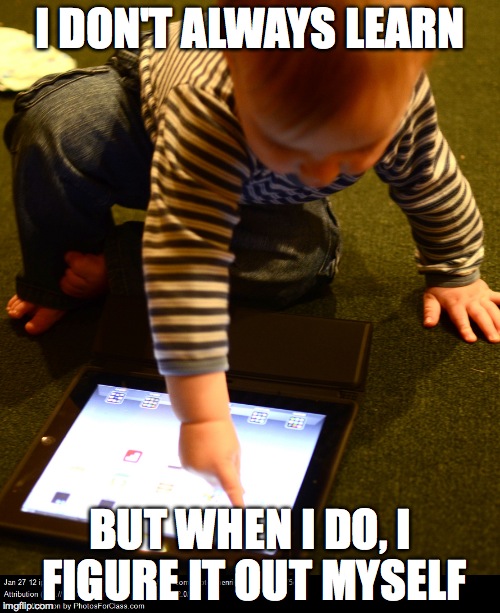
My meme above is supposed to depict the "problem-solving gene" that Digital Natives have. Digital natives are fearless when it comes to technology and can pioneer through a new device and teach themselves how to use it. Then, they often transfer this skill into teaching and helping others.
Thursday, June 11, 2015
Digital Natives: Reflecting on the Myth
After reading the beginning of our course text, Deconstructing Digital Natives: Young People, Technology, and the New Literacies, many quotes stood out to me. Below is an excerpt from the Foreword:
"Ultimately, the digital natives argument tends to essentialize generations - and in the process to 'exoticize' young people, to make them seem inherently strange and different."
As a 24-year-old who is amongst the youngest in my profession, I often observe the split between my elder colleagues' and my students' usage of technology, specifically cell phones. I am most usually right in the middle of that split. I had a cell phone throughout high school and would consider my cell phone usage today to be very high. With that being said, I don't feel the need to be on it incessantly, like some of my students. I identify with this quote because I often see and hear the negative comments about young people being stuck in their phones, and the negative connotations that come along with that habit. I use Twitter, Instagram, Facebook, and more, and although these outlets can be strictly entertainment at times, they are very large sources of information and learning. This quote sheds light on what people perceive that cell phones are used for: social media and gaming. Hence, they label these habits as weird or different, but social media outlets contain International News platforms, factual information, and endless resources to today's young people. Many times our young people use these platforms for learning purposes, which is not recognized enough. If a student had their nose stuck in a newspaper every day, would bad light be shed on them? Probably not, even though they are getting some of the same information from the newspaper that they could from a Twitter page, not to mention that they could have read about the same topic on Twitter hours before they can get it from a newspaper.
In Chapter 1, Michael Thomas wrote about some of the positives of young people's technology use and how it is transforming them in the workplace:
"...digital natives are problem-solvers; they have new expectations; they invent new processes; they don't only work for an organization, they think of work as play; they are enthusiastic and skillful."
I completely agree with this quote on page 4 of our text. Growing up with digital resources at my fingertips, I have fun while simply scouring the internet for new resources for my students. I feel that although I do not know nearly enough about technology, I am proficient in many skills that allow me to do this and I am thankful for that. I think many digital natives have the ability to see through the internet what is possible in their respective professions, therefore push themselves each day to be better than they were the day before.
A short and sweet definition of what it means to be a digital native is included in Chapter 2:
"So to me, being a digital native is about growing up in a digital country or culture, as opposed to coming to it as an adult."
Change is hard, in any aspect. I think this is one of the main reasons why there are people that deem Digital Natives as weird or different. Many, but not all, people who did not grow up with the opportunity to learn through new technologies as young children have a hard time adapting to the new resources and a hard time understanding why students now do not want to use a book to reference, but would rather simply Google or YouTube something. It is right at our fingertips in a matter of seconds using the internet and although books can get us to arrive at the same conclusions, in today's world efficiency is key.
Drawing again on the advantages of social media outlets, I have picked the following message from Chapter 3:
"A related move in education is away from the institutional provision of learning systems, variously called learning management systems (LMSs), course management systems (CMSs), and virtual learning environments (VLEs) - such as Blackboard, WebCT, and their open source competitors Moodle and Sakai - and towards personal learning environments (PLEs) (Weller, 2007)."
I like this quote because it emphasizes the change in the student's role. In a PLE, the student has more responsibility to communicate and understand ideas by navigating through information. PLEs can include social networking, which also allow for a student to be in an environment where they feel comfortable and proficient in using the tool at hand.
My thinking towards digital natives has changed somewhat after reading these chapters in the fact that there are even more positives than I thought to be talked about and discussed towards the younger generation's technological abilities. It has opened my eyes to a lot of different perspectives towards this group of learners and different ways to facilitate their learning, by ways such as using a PLE.

"Ultimately, the digital natives argument tends to essentialize generations - and in the process to 'exoticize' young people, to make them seem inherently strange and different."
As a 24-year-old who is amongst the youngest in my profession, I often observe the split between my elder colleagues' and my students' usage of technology, specifically cell phones. I am most usually right in the middle of that split. I had a cell phone throughout high school and would consider my cell phone usage today to be very high. With that being said, I don't feel the need to be on it incessantly, like some of my students. I identify with this quote because I often see and hear the negative comments about young people being stuck in their phones, and the negative connotations that come along with that habit. I use Twitter, Instagram, Facebook, and more, and although these outlets can be strictly entertainment at times, they are very large sources of information and learning. This quote sheds light on what people perceive that cell phones are used for: social media and gaming. Hence, they label these habits as weird or different, but social media outlets contain International News platforms, factual information, and endless resources to today's young people. Many times our young people use these platforms for learning purposes, which is not recognized enough. If a student had their nose stuck in a newspaper every day, would bad light be shed on them? Probably not, even though they are getting some of the same information from the newspaper that they could from a Twitter page, not to mention that they could have read about the same topic on Twitter hours before they can get it from a newspaper.
In Chapter 1, Michael Thomas wrote about some of the positives of young people's technology use and how it is transforming them in the workplace:
"...digital natives are problem-solvers; they have new expectations; they invent new processes; they don't only work for an organization, they think of work as play; they are enthusiastic and skillful."
I completely agree with this quote on page 4 of our text. Growing up with digital resources at my fingertips, I have fun while simply scouring the internet for new resources for my students. I feel that although I do not know nearly enough about technology, I am proficient in many skills that allow me to do this and I am thankful for that. I think many digital natives have the ability to see through the internet what is possible in their respective professions, therefore push themselves each day to be better than they were the day before.
A short and sweet definition of what it means to be a digital native is included in Chapter 2:
"So to me, being a digital native is about growing up in a digital country or culture, as opposed to coming to it as an adult."
Change is hard, in any aspect. I think this is one of the main reasons why there are people that deem Digital Natives as weird or different. Many, but not all, people who did not grow up with the opportunity to learn through new technologies as young children have a hard time adapting to the new resources and a hard time understanding why students now do not want to use a book to reference, but would rather simply Google or YouTube something. It is right at our fingertips in a matter of seconds using the internet and although books can get us to arrive at the same conclusions, in today's world efficiency is key.
Drawing again on the advantages of social media outlets, I have picked the following message from Chapter 3:
"A related move in education is away from the institutional provision of learning systems, variously called learning management systems (LMSs), course management systems (CMSs), and virtual learning environments (VLEs) - such as Blackboard, WebCT, and their open source competitors Moodle and Sakai - and towards personal learning environments (PLEs) (Weller, 2007)."
I like this quote because it emphasizes the change in the student's role. In a PLE, the student has more responsibility to communicate and understand ideas by navigating through information. PLEs can include social networking, which also allow for a student to be in an environment where they feel comfortable and proficient in using the tool at hand.
My thinking towards digital natives has changed somewhat after reading these chapters in the fact that there are even more positives than I thought to be talked about and discussed towards the younger generation's technological abilities. It has opened my eyes to a lot of different perspectives towards this group of learners and different ways to facilitate their learning, by ways such as using a PLE.
Growing with Technology

I chose the picture above because I think it depicts what it means to be a Digital Native: to grow as a person while learning via technology.
Monday, June 1, 2015
Digital Media Effects on Conventional Reading and Writing Practices
Reactions to Articles about Digital Media Effects on Reading and Writing
From the article Literacy Debate: Online R U Really Reading?, I have chosen to write about the following quote:
"Some Web evangelists say children should be evaluated for their proficiency on the Internet just as they are tested on their print reading comprehension. Starting next year, some countries will participate in new international assessments of digital literacy, but the United States, for now, will not."
I had a strong positive reaction to this quote. Assessments such as research projects and book reports have previously evaluated a student on his or her ability to use their given resources to communicate main ideas and an understanding of certain topics. Now, let's be honest about the day in age that we are living in. The vast majority of students and teachers alike have easy access to the wonderful world wide web. Sure, we have all caught ourselves using this tool as a distraction mechanism, but we can also use it to help better ourselves in our professional lives. I use the internet almost daily to scour the web for resources and activities to use with my students. This is something I have had to somewhat teach myself and it has become very beneficial to me on many occasions, and would do so for a large amount of careers. I believe it would be beneficial to some extent to evaluate students on their internet capabilities. For example, rather than a book report, students could complete a web quest.
The second article, Does Digital Media Make Us Bad Writers?, had various quotes that talked about the debate of declining literacy due to new age digital media. Below is an excerpt that I particularly enjoyed.
"Ultimately, argues Baron, the writing challenges created by digital media are not unlike those faced when in the 1980s when word processing hit college campuses. Baron says that tools like spell check and the ability to move text from place to place temporarily resulted in a step backwards."
I thoroughly agree with the fact that although we may have temporary setbacks due to the conveniences of digital media, they are just hurdles that we have to jump and eventually overcome. Eventually, we will learn to use the tools we are given as they are intended to be used and not abuse them.
My Thoughts
On the continuum between Web Evangelist to Traditionalist, I would say that I am definitely not 100% on one side or the other. I see the advantages, and disadvantages, to both the Web Evangelist end of the spectrum and the Traditionalist end, although I definitely lie closer to the Web Evangelist. I believe that the pros of using the digital media we have been exposed to greatly outweigh the cons. From the above articles, the story about Zachary Sims under the sub-heading But This Is Reading Too, would most closely relate to my stand point. Zach reaps the benefits of using the new age digital media, but also enjoys reading books. Alongside that point, I myself enjoy reading but most usually via Kindle or iBooks. I enjoy the convenience of buying it over the internet and reading it right then. In doing so, I am reading a book but using a digital platform to do so.

Resources:
Karp, Josh. "Does Digital Media Make Us Bad Writers? | Spotlight on Digital Media and Learning." Does Digital Media Make Us Bad Writers? 26 Jan. 2010. Web. 1 June 2015.
Rich, Motoko. "Literacy Debate: Online, R U Really Reading?" The New York Times. The New York Times, 26 July 2008. Web. 1 June 2015.
From the article Literacy Debate: Online R U Really Reading?, I have chosen to write about the following quote:
"Some Web evangelists say children should be evaluated for their proficiency on the Internet just as they are tested on their print reading comprehension. Starting next year, some countries will participate in new international assessments of digital literacy, but the United States, for now, will not."
I had a strong positive reaction to this quote. Assessments such as research projects and book reports have previously evaluated a student on his or her ability to use their given resources to communicate main ideas and an understanding of certain topics. Now, let's be honest about the day in age that we are living in. The vast majority of students and teachers alike have easy access to the wonderful world wide web. Sure, we have all caught ourselves using this tool as a distraction mechanism, but we can also use it to help better ourselves in our professional lives. I use the internet almost daily to scour the web for resources and activities to use with my students. This is something I have had to somewhat teach myself and it has become very beneficial to me on many occasions, and would do so for a large amount of careers. I believe it would be beneficial to some extent to evaluate students on their internet capabilities. For example, rather than a book report, students could complete a web quest.
The second article, Does Digital Media Make Us Bad Writers?, had various quotes that talked about the debate of declining literacy due to new age digital media. Below is an excerpt that I particularly enjoyed.
"Ultimately, argues Baron, the writing challenges created by digital media are not unlike those faced when in the 1980s when word processing hit college campuses. Baron says that tools like spell check and the ability to move text from place to place temporarily resulted in a step backwards."
I thoroughly agree with the fact that although we may have temporary setbacks due to the conveniences of digital media, they are just hurdles that we have to jump and eventually overcome. Eventually, we will learn to use the tools we are given as they are intended to be used and not abuse them.
My Thoughts
On the continuum between Web Evangelist to Traditionalist, I would say that I am definitely not 100% on one side or the other. I see the advantages, and disadvantages, to both the Web Evangelist end of the spectrum and the Traditionalist end, although I definitely lie closer to the Web Evangelist. I believe that the pros of using the digital media we have been exposed to greatly outweigh the cons. From the above articles, the story about Zachary Sims under the sub-heading But This Is Reading Too, would most closely relate to my stand point. Zach reaps the benefits of using the new age digital media, but also enjoys reading books. Alongside that point, I myself enjoy reading but most usually via Kindle or iBooks. I enjoy the convenience of buying it over the internet and reading it right then. In doing so, I am reading a book but using a digital platform to do so.
Print-Aided Technology

Resources:
Karp, Josh. "Does Digital Media Make Us Bad Writers? | Spotlight on Digital Media and Learning." Does Digital Media Make Us Bad Writers? 26 Jan. 2010. Web. 1 June 2015.
Texting and Multi-modal Texts
After watching the video above, I summarized what I had learned. The most important things I learned from the video are what pragmatic particles are, that literacy has always had deficiencies, even before texting, and the uses of various literacy types. But the most important thing I learned is texting is an additional skill, not a replacement.
I am a high school math teacher and Blabberize would be a great outlet to use for short bursts of information, such as the steps to complete a given process. For example, if a student's topic was Square Root Equations, they could summarize the following steps into a Blabberize:
To solve an equation containing square roots, we must
- Get the radical by itself
- Square both sides of the equation
- Use inverse operations to solve the remaining equation
This example could be translated into many different processes in a high school math class.
Sunday, May 31, 2015
Disruption: The role of image in communication.
After reading Disruptions: Social Media Images Form a New Language Online, I found many things that I agree with and found the article to be very informational and engaging. As a math-minded person, I appreciated the fact that the information was supported by numerical data. Although I know that these numbers were correct, the context clues in the paragraphs insinuated some things that I did not completely agree with. I am referring to the quote below:
"It’s a shift that appears to be coming at the expense of the last big thing. Images sent between cellphones are on the rise as text messages continue to fall, according to CTIA, the trade association for the wireless industry. An industry report released this year said 2.19 trillion text messages were sent and received in 2012, about 5 percent less than a year earlier. In comparison, MMS, or multimedia messages that include photos and videos, grew by 41 percent to 74.5 billion in 2012."
From this excerpt, and the article in its entirety, you can gather that the author is using these facts in order to try to prove that text-based information is losing its importance because multimedia messages are increasing and the old-fashioned text message numbers are decreasing. While I do whole-heartedly believe that textual information and communication is declining, I disagree with the numerical data they have chosen to support this claim. The reason for this is because there is a lot of information they are leaving out. Although the plain old text message numbers are decreasing, they leave out the fact that many social media outlets include text-messaging applications. Facebook has Facebook Chat, Twitter has Direct Messaging, SnapChat has a one-on-one chat messenger, and these are just the social media outlets that I am familiar with that all offer textual communication.
In addition to this, the article does not indicate whether it is including an "iMessage" as a "text message." iMessage is the chat feature for Apple users to message other Apple users. This can be done on a Mac Computer, iPad, iPhone, and even iPod touch. While you can send pictures, videos, and audio messages via iMessage, you may also send plain text. This raises another question to the excerpt that I included above. Do they include iMessage data in the statistics that they have cited? According to an article from AppleInsider written about a study done by the NPD Group, which is the Global Market Research and Business Solutions, in the fourth quarter of 2013, the iPhone represented 42% of the smartphones owned in the U.S. Although this study does not represent world wide numbers, this is an example of the chunk of data that is being left out of the article if they are dismissing iMessage as a text message.
In closing, I would like to reiterate that I agree with the article as a whole. I would be interested to see the extension of the article from the standpoint of textual communication via multimedia applications and iMessages, including those sent from MacBooks, Mac Desktops, iPads, iPods, and more.

"It’s a shift that appears to be coming at the expense of the last big thing. Images sent between cellphones are on the rise as text messages continue to fall, according to CTIA, the trade association for the wireless industry. An industry report released this year said 2.19 trillion text messages were sent and received in 2012, about 5 percent less than a year earlier. In comparison, MMS, or multimedia messages that include photos and videos, grew by 41 percent to 74.5 billion in 2012."
From this excerpt, and the article in its entirety, you can gather that the author is using these facts in order to try to prove that text-based information is losing its importance because multimedia messages are increasing and the old-fashioned text message numbers are decreasing. While I do whole-heartedly believe that textual information and communication is declining, I disagree with the numerical data they have chosen to support this claim. The reason for this is because there is a lot of information they are leaving out. Although the plain old text message numbers are decreasing, they leave out the fact that many social media outlets include text-messaging applications. Facebook has Facebook Chat, Twitter has Direct Messaging, SnapChat has a one-on-one chat messenger, and these are just the social media outlets that I am familiar with that all offer textual communication.
In addition to this, the article does not indicate whether it is including an "iMessage" as a "text message." iMessage is the chat feature for Apple users to message other Apple users. This can be done on a Mac Computer, iPad, iPhone, and even iPod touch. While you can send pictures, videos, and audio messages via iMessage, you may also send plain text. This raises another question to the excerpt that I included above. Do they include iMessage data in the statistics that they have cited? According to an article from AppleInsider written about a study done by the NPD Group, which is the Global Market Research and Business Solutions, in the fourth quarter of 2013, the iPhone represented 42% of the smartphones owned in the U.S. Although this study does not represent world wide numbers, this is an example of the chunk of data that is being left out of the article if they are dismissing iMessage as a text message.
In closing, I would like to reiterate that I agree with the article as a whole. I would be interested to see the extension of the article from the standpoint of textual communication via multimedia applications and iMessages, including those sent from MacBooks, Mac Desktops, iPads, iPods, and more.
Picturing Something New

Resources
Bilton, N. (2013, June 30). Disruptions: Social Media Images Form a New Language Online. Retrieved May 29, 2015, from http://bits.blogs.nytimes.com/2013/06/30/disruptions-social-media-images-form-a-new-language-online/?_r=1
Hughes, Neil. "Apple's IPhone Now Represents 42% of Smartphones Owned in the US - NPD." Apple's IPhone Now Represents 42% of Smartphones Owned in the US - NPD. 16 Jan. 2014. Web. 31 May 2015.
Introductory Post
Hello, all! My name is Natalie Hathaway and I am beginning my first semester as a graduate student at Fairmont State University. I am from Harrison County in North Central West Virginia. I am a high school math teacher in Harrison County, where I am an assistant supervisor to our Student Council, and I am the head coach of a middle school cheerleading squad. In my free time I like to spend time out on the lake boating or just hanging out with my family and friends.
I am taking this class to gain a better understanding of the use of digital media and technology in the classroom in order to better myself as an educator. I am taking this class as part of my graduate program, which is the Professional Studies program. I have not completed any classes so far, as this is my first semester.
To start, I have found a YouTube video that embodies my personal understanding of what it means to be literate in the 21st century. In this commercial, entitled The Power of Literacy, we see how literacy does not mean to just be able to read or write, but it enables us to connect with one another and how to get more out of life.
If you are reading this and are also part of this course or graduate program, feel free to follow me and I will do the same for your blog! I look forward to working with and learning from you all.

I am taking this class to gain a better understanding of the use of digital media and technology in the classroom in order to better myself as an educator. I am taking this class as part of my graduate program, which is the Professional Studies program. I have not completed any classes so far, as this is my first semester.
To start, I have found a YouTube video that embodies my personal understanding of what it means to be literate in the 21st century. In this commercial, entitled The Power of Literacy, we see how literacy does not mean to just be able to read or write, but it enables us to connect with one another and how to get more out of life.
If you are reading this and are also part of this course or graduate program, feel free to follow me and I will do the same for your blog! I look forward to working with and learning from you all.

Subscribe to:
Comments (Atom)