Below I have included excerpts from Chapters 4, 5, and 6 in Deconstructing Digital Natives: Young People, Technology, and the New Literacies that I had a strong reaction to.
Chapter 4:
"...the assumption that young people are "Digital Natives" can have profound impacts on the ways in which they are addressed by civic organizations and on the expectations displayed in the deployment of technological tools on websites."
I chose this quote from chapter 4 because I feel that this depicts another downfall of being a Digital Native in today's world. While most employers have had to adapt to the digital age, the newcomers to the workforce most likely grew up with technology, and more is expected of them. Although this expectation is somewhat deserved, I don't feel that young people should be subjected to live up to higher expectations because they grew up with different inventions surrounding them.
Chapter 5:
"...audiences are not necessarily structured by the television producers in terms of time-space. They shift its time and space from the hitherto domesticated viewing context to their everyday context while also selecting people for co-viewing."
I chose this quote because it sheds light on the way that technology is changing the way that businesses have to run. Technology has given us, the consumers, more power in the product that we are buying, thus changing the way that we use the product. Many people have chosen to opt out of cable television while simply paying for internet services such as Hulu, Netflix, Vudu, and more. This change will continue to change the way that businesses such as Cable TV providers run and what services they offer to their customers.
Chapter 6:
"Characterizing young learners as a homogeneous group through the use of terms such as "Digital Natives" is problematic for a number of reasons, but the main one is that through a broad generalization such terms gloss over the need to identify and recognize difference."
I chose this quote because although so many of our students today are wonderful with technology, there are still instances where a student is not proficient in these skills. Students also have various different learning styles in which they learn best from. It is necessary that we examine and pay attention to all learning styles as an educator. In addition to this, we also need to recognize the difference in being sufficient with technology and those that are exceptional with technology in order to help aid these special students to the best of our ability.
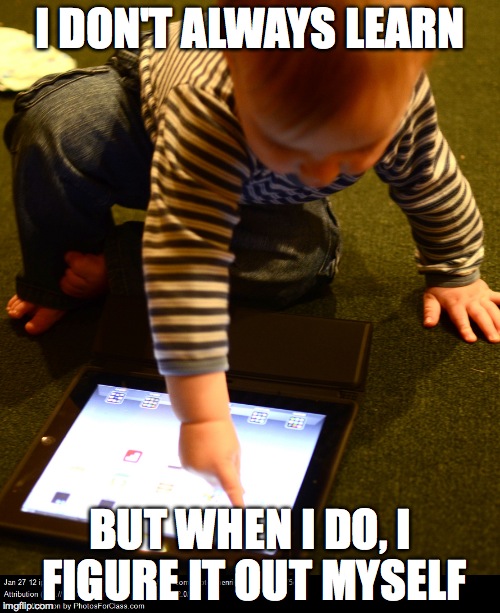
My meme above is supposed to depict the "problem-solving gene" that Digital Natives have. Digital natives are fearless when it comes to technology and can pioneer through a new device and teach themselves how to use it. Then, they often transfer this skill into teaching and helping others.

Natalie-
ReplyDeleteWhen I read this blog, I felt like you were reading my mind when I wrote mine! We both chose the same quotes from chapter 5 and chapter 6. I wrote mine from a more personal points of view, whereas yours is more geared toward our students. I really like and agree with what you said about the different learning styles that students have and how we must take that into consideration so that we can recognize differences and make sure that we are reaching ALL of our students.
Your meme is spot on from the readings and a "truth" about digital natives. I agree that digital natives can take a new piece of technology and figure it out for themselves. They see to want to just get it and go, especially in the classroom, and not wait for instructions and seem hesitant to ask questions. Then, when they figure it out, they are very proud and want to tell someone else how to do it.
Your Meme is really funny and true. I have learned a lot of things on my own (sometimes with the help of Google); I tend to dive into things and see what happens.
ReplyDeleteYour response to the quote you chose from chapter four is great. I hope people do not assume I am up-to-date on the latest technologies just because I am considered a digital native. I also agree with your response to your chapter five quote. The invention of the DVR changed my life; I’m really not sure what day or time my favorite shows air because my DVR is programmed to record new episodes; I just check the DVR and watch them. Your chapter six quote goes along with your quote from chapter four. Categorizing all young people as “Digital Natives,” isn’t fair when some have unlimited access to technology and others do not.
Natalie,
ReplyDeleteI love you Meme! It is so true and goes perfectly with our book. I wish some of my students were more like that and tried to figure stuff out on their own.
I completely agree with your quote and reasoning for chapter 6. A lot of my students don't have a computer or internet access at home, which means that they are nearly as good with technology compared to the ones that do. When I take my kids to the computer lab some have a hard time working the internet to find the website that they need to use. I was really nervous when I heard about smarter balance, because it is all them on the computer and part of the teacher.
Awesome quotes! I used the first quote you had myself. The quote from chapter 5 was interesting and definitely holds true. Business will always pinpoint these fiscal weaknesses that we have to get us to spend more of our money. That's just good business I guess. The meme you made reminds me of the time I watching my friends 2 year old. I downloaded some games on my phone for him to play and he loved playing them. They were simple games, like popping a bubble to release animals, but he figured out how to play them quickly.
ReplyDelete