Chapter 7:
"Increasingly, in the public debate on youth and popular culture, media have become the defining factor dividing generations."
While I see the reasoning behind this statement, I tend to disagree with the quote as a whole. I see how digital media can separate generations and make the 'generation gap' larger. At the same time, I see it as a way to bring generations together. This week I have a date with my grandma to help teach her how to clean off her iPad onto her computer so she can use it to take pictures again. I am also an assistant student council advisor at my school and this year we are organizing for students to help the elderly in our community learn technology. Whether the technology is a phone, tablet, iPod, television, students will either be able to help or can try to figure it out together with the owner.
Chapter 8:
"...how the Internet and the many digital tools available on the Web have affected the way students seek and gather information in the context of higher education."
I definitely agree with this statement. I am guilty of searching for the quick fix at times when I am in a hurry to get an assignment done. I think that better instruction on how to use the internet for academic purposes can help curb this problem, as well as better informing students on the amount of incorrect information that can be found on the internet.
Chapter 9:
"In addition, he implies that adults should improve their listening in relation to young people. There is a requirement for an audience and the belief that one's opinions are being heard (Rheingold, 2008)."
I strongly agree with the excerpt that I included from Chapter 9. Without showing students that we are interested in their thoughts and opinions, we are immediately shutting off their thinking process and diminishing any further growth in that area. I think it is crucial for us as educators to make sure that the conversation in the classroom is a two-way street, not just us presenting information without getting feedback, thought-provoking questions, and opinions from students.
Monday, June 22, 2015

Thursday, June 18, 2015
The Civic, Social and Multi Modal Lives of Digital Natives
Below I have included excerpts from Chapters 4, 5, and 6 in Deconstructing Digital Natives: Young People, Technology, and the New Literacies that I had a strong reaction to.
Chapter 4:
"...the assumption that young people are "Digital Natives" can have profound impacts on the ways in which they are addressed by civic organizations and on the expectations displayed in the deployment of technological tools on websites."
I chose this quote from chapter 4 because I feel that this depicts another downfall of being a Digital Native in today's world. While most employers have had to adapt to the digital age, the newcomers to the workforce most likely grew up with technology, and more is expected of them. Although this expectation is somewhat deserved, I don't feel that young people should be subjected to live up to higher expectations because they grew up with different inventions surrounding them.
Chapter 5:
"...audiences are not necessarily structured by the television producers in terms of time-space. They shift its time and space from the hitherto domesticated viewing context to their everyday context while also selecting people for co-viewing."
I chose this quote because it sheds light on the way that technology is changing the way that businesses have to run. Technology has given us, the consumers, more power in the product that we are buying, thus changing the way that we use the product. Many people have chosen to opt out of cable television while simply paying for internet services such as Hulu, Netflix, Vudu, and more. This change will continue to change the way that businesses such as Cable TV providers run and what services they offer to their customers.
Chapter 6:
"Characterizing young learners as a homogeneous group through the use of terms such as "Digital Natives" is problematic for a number of reasons, but the main one is that through a broad generalization such terms gloss over the need to identify and recognize difference."
I chose this quote because although so many of our students today are wonderful with technology, there are still instances where a student is not proficient in these skills. Students also have various different learning styles in which they learn best from. It is necessary that we examine and pay attention to all learning styles as an educator. In addition to this, we also need to recognize the difference in being sufficient with technology and those that are exceptional with technology in order to help aid these special students to the best of our ability.
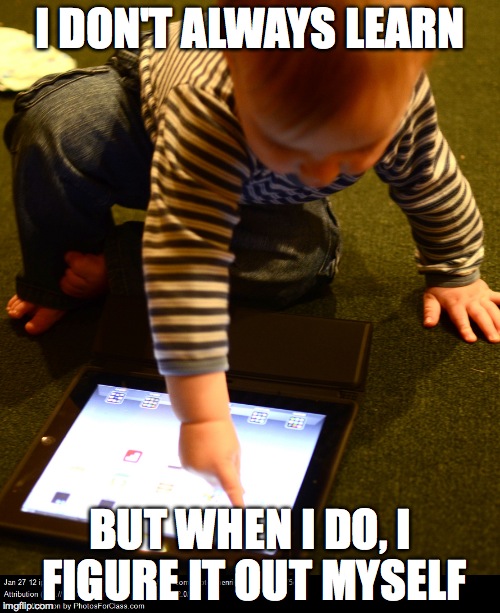
My meme above is supposed to depict the "problem-solving gene" that Digital Natives have. Digital natives are fearless when it comes to technology and can pioneer through a new device and teach themselves how to use it. Then, they often transfer this skill into teaching and helping others.
Thursday, June 11, 2015
Digital Natives: Reflecting on the Myth
After reading the beginning of our course text, Deconstructing Digital Natives: Young People, Technology, and the New Literacies, many quotes stood out to me. Below is an excerpt from the Foreword:
"Ultimately, the digital natives argument tends to essentialize generations - and in the process to 'exoticize' young people, to make them seem inherently strange and different."
As a 24-year-old who is amongst the youngest in my profession, I often observe the split between my elder colleagues' and my students' usage of technology, specifically cell phones. I am most usually right in the middle of that split. I had a cell phone throughout high school and would consider my cell phone usage today to be very high. With that being said, I don't feel the need to be on it incessantly, like some of my students. I identify with this quote because I often see and hear the negative comments about young people being stuck in their phones, and the negative connotations that come along with that habit. I use Twitter, Instagram, Facebook, and more, and although these outlets can be strictly entertainment at times, they are very large sources of information and learning. This quote sheds light on what people perceive that cell phones are used for: social media and gaming. Hence, they label these habits as weird or different, but social media outlets contain International News platforms, factual information, and endless resources to today's young people. Many times our young people use these platforms for learning purposes, which is not recognized enough. If a student had their nose stuck in a newspaper every day, would bad light be shed on them? Probably not, even though they are getting some of the same information from the newspaper that they could from a Twitter page, not to mention that they could have read about the same topic on Twitter hours before they can get it from a newspaper.
In Chapter 1, Michael Thomas wrote about some of the positives of young people's technology use and how it is transforming them in the workplace:
"...digital natives are problem-solvers; they have new expectations; they invent new processes; they don't only work for an organization, they think of work as play; they are enthusiastic and skillful."
I completely agree with this quote on page 4 of our text. Growing up with digital resources at my fingertips, I have fun while simply scouring the internet for new resources for my students. I feel that although I do not know nearly enough about technology, I am proficient in many skills that allow me to do this and I am thankful for that. I think many digital natives have the ability to see through the internet what is possible in their respective professions, therefore push themselves each day to be better than they were the day before.
A short and sweet definition of what it means to be a digital native is included in Chapter 2:
"So to me, being a digital native is about growing up in a digital country or culture, as opposed to coming to it as an adult."
Change is hard, in any aspect. I think this is one of the main reasons why there are people that deem Digital Natives as weird or different. Many, but not all, people who did not grow up with the opportunity to learn through new technologies as young children have a hard time adapting to the new resources and a hard time understanding why students now do not want to use a book to reference, but would rather simply Google or YouTube something. It is right at our fingertips in a matter of seconds using the internet and although books can get us to arrive at the same conclusions, in today's world efficiency is key.
Drawing again on the advantages of social media outlets, I have picked the following message from Chapter 3:
"A related move in education is away from the institutional provision of learning systems, variously called learning management systems (LMSs), course management systems (CMSs), and virtual learning environments (VLEs) - such as Blackboard, WebCT, and their open source competitors Moodle and Sakai - and towards personal learning environments (PLEs) (Weller, 2007)."
I like this quote because it emphasizes the change in the student's role. In a PLE, the student has more responsibility to communicate and understand ideas by navigating through information. PLEs can include social networking, which also allow for a student to be in an environment where they feel comfortable and proficient in using the tool at hand.
My thinking towards digital natives has changed somewhat after reading these chapters in the fact that there are even more positives than I thought to be talked about and discussed towards the younger generation's technological abilities. It has opened my eyes to a lot of different perspectives towards this group of learners and different ways to facilitate their learning, by ways such as using a PLE.

"Ultimately, the digital natives argument tends to essentialize generations - and in the process to 'exoticize' young people, to make them seem inherently strange and different."
As a 24-year-old who is amongst the youngest in my profession, I often observe the split between my elder colleagues' and my students' usage of technology, specifically cell phones. I am most usually right in the middle of that split. I had a cell phone throughout high school and would consider my cell phone usage today to be very high. With that being said, I don't feel the need to be on it incessantly, like some of my students. I identify with this quote because I often see and hear the negative comments about young people being stuck in their phones, and the negative connotations that come along with that habit. I use Twitter, Instagram, Facebook, and more, and although these outlets can be strictly entertainment at times, they are very large sources of information and learning. This quote sheds light on what people perceive that cell phones are used for: social media and gaming. Hence, they label these habits as weird or different, but social media outlets contain International News platforms, factual information, and endless resources to today's young people. Many times our young people use these platforms for learning purposes, which is not recognized enough. If a student had their nose stuck in a newspaper every day, would bad light be shed on them? Probably not, even though they are getting some of the same information from the newspaper that they could from a Twitter page, not to mention that they could have read about the same topic on Twitter hours before they can get it from a newspaper.
In Chapter 1, Michael Thomas wrote about some of the positives of young people's technology use and how it is transforming them in the workplace:
"...digital natives are problem-solvers; they have new expectations; they invent new processes; they don't only work for an organization, they think of work as play; they are enthusiastic and skillful."
I completely agree with this quote on page 4 of our text. Growing up with digital resources at my fingertips, I have fun while simply scouring the internet for new resources for my students. I feel that although I do not know nearly enough about technology, I am proficient in many skills that allow me to do this and I am thankful for that. I think many digital natives have the ability to see through the internet what is possible in their respective professions, therefore push themselves each day to be better than they were the day before.
A short and sweet definition of what it means to be a digital native is included in Chapter 2:
"So to me, being a digital native is about growing up in a digital country or culture, as opposed to coming to it as an adult."
Change is hard, in any aspect. I think this is one of the main reasons why there are people that deem Digital Natives as weird or different. Many, but not all, people who did not grow up with the opportunity to learn through new technologies as young children have a hard time adapting to the new resources and a hard time understanding why students now do not want to use a book to reference, but would rather simply Google or YouTube something. It is right at our fingertips in a matter of seconds using the internet and although books can get us to arrive at the same conclusions, in today's world efficiency is key.
Drawing again on the advantages of social media outlets, I have picked the following message from Chapter 3:
"A related move in education is away from the institutional provision of learning systems, variously called learning management systems (LMSs), course management systems (CMSs), and virtual learning environments (VLEs) - such as Blackboard, WebCT, and their open source competitors Moodle and Sakai - and towards personal learning environments (PLEs) (Weller, 2007)."
I like this quote because it emphasizes the change in the student's role. In a PLE, the student has more responsibility to communicate and understand ideas by navigating through information. PLEs can include social networking, which also allow for a student to be in an environment where they feel comfortable and proficient in using the tool at hand.
My thinking towards digital natives has changed somewhat after reading these chapters in the fact that there are even more positives than I thought to be talked about and discussed towards the younger generation's technological abilities. It has opened my eyes to a lot of different perspectives towards this group of learners and different ways to facilitate their learning, by ways such as using a PLE.
Growing with Technology

I chose the picture above because I think it depicts what it means to be a Digital Native: to grow as a person while learning via technology.
Monday, June 1, 2015
Digital Media Effects on Conventional Reading and Writing Practices
Reactions to Articles about Digital Media Effects on Reading and Writing
From the article Literacy Debate: Online R U Really Reading?, I have chosen to write about the following quote:
"Some Web evangelists say children should be evaluated for their proficiency on the Internet just as they are tested on their print reading comprehension. Starting next year, some countries will participate in new international assessments of digital literacy, but the United States, for now, will not."
I had a strong positive reaction to this quote. Assessments such as research projects and book reports have previously evaluated a student on his or her ability to use their given resources to communicate main ideas and an understanding of certain topics. Now, let's be honest about the day in age that we are living in. The vast majority of students and teachers alike have easy access to the wonderful world wide web. Sure, we have all caught ourselves using this tool as a distraction mechanism, but we can also use it to help better ourselves in our professional lives. I use the internet almost daily to scour the web for resources and activities to use with my students. This is something I have had to somewhat teach myself and it has become very beneficial to me on many occasions, and would do so for a large amount of careers. I believe it would be beneficial to some extent to evaluate students on their internet capabilities. For example, rather than a book report, students could complete a web quest.
The second article, Does Digital Media Make Us Bad Writers?, had various quotes that talked about the debate of declining literacy due to new age digital media. Below is an excerpt that I particularly enjoyed.
"Ultimately, argues Baron, the writing challenges created by digital media are not unlike those faced when in the 1980s when word processing hit college campuses. Baron says that tools like spell check and the ability to move text from place to place temporarily resulted in a step backwards."
I thoroughly agree with the fact that although we may have temporary setbacks due to the conveniences of digital media, they are just hurdles that we have to jump and eventually overcome. Eventually, we will learn to use the tools we are given as they are intended to be used and not abuse them.
My Thoughts
On the continuum between Web Evangelist to Traditionalist, I would say that I am definitely not 100% on one side or the other. I see the advantages, and disadvantages, to both the Web Evangelist end of the spectrum and the Traditionalist end, although I definitely lie closer to the Web Evangelist. I believe that the pros of using the digital media we have been exposed to greatly outweigh the cons. From the above articles, the story about Zachary Sims under the sub-heading But This Is Reading Too, would most closely relate to my stand point. Zach reaps the benefits of using the new age digital media, but also enjoys reading books. Alongside that point, I myself enjoy reading but most usually via Kindle or iBooks. I enjoy the convenience of buying it over the internet and reading it right then. In doing so, I am reading a book but using a digital platform to do so.

Resources:
Karp, Josh. "Does Digital Media Make Us Bad Writers? | Spotlight on Digital Media and Learning." Does Digital Media Make Us Bad Writers? 26 Jan. 2010. Web. 1 June 2015.
Rich, Motoko. "Literacy Debate: Online, R U Really Reading?" The New York Times. The New York Times, 26 July 2008. Web. 1 June 2015.
From the article Literacy Debate: Online R U Really Reading?, I have chosen to write about the following quote:
"Some Web evangelists say children should be evaluated for their proficiency on the Internet just as they are tested on their print reading comprehension. Starting next year, some countries will participate in new international assessments of digital literacy, but the United States, for now, will not."
I had a strong positive reaction to this quote. Assessments such as research projects and book reports have previously evaluated a student on his or her ability to use their given resources to communicate main ideas and an understanding of certain topics. Now, let's be honest about the day in age that we are living in. The vast majority of students and teachers alike have easy access to the wonderful world wide web. Sure, we have all caught ourselves using this tool as a distraction mechanism, but we can also use it to help better ourselves in our professional lives. I use the internet almost daily to scour the web for resources and activities to use with my students. This is something I have had to somewhat teach myself and it has become very beneficial to me on many occasions, and would do so for a large amount of careers. I believe it would be beneficial to some extent to evaluate students on their internet capabilities. For example, rather than a book report, students could complete a web quest.
The second article, Does Digital Media Make Us Bad Writers?, had various quotes that talked about the debate of declining literacy due to new age digital media. Below is an excerpt that I particularly enjoyed.
"Ultimately, argues Baron, the writing challenges created by digital media are not unlike those faced when in the 1980s when word processing hit college campuses. Baron says that tools like spell check and the ability to move text from place to place temporarily resulted in a step backwards."
I thoroughly agree with the fact that although we may have temporary setbacks due to the conveniences of digital media, they are just hurdles that we have to jump and eventually overcome. Eventually, we will learn to use the tools we are given as they are intended to be used and not abuse them.
My Thoughts
On the continuum between Web Evangelist to Traditionalist, I would say that I am definitely not 100% on one side or the other. I see the advantages, and disadvantages, to both the Web Evangelist end of the spectrum and the Traditionalist end, although I definitely lie closer to the Web Evangelist. I believe that the pros of using the digital media we have been exposed to greatly outweigh the cons. From the above articles, the story about Zachary Sims under the sub-heading But This Is Reading Too, would most closely relate to my stand point. Zach reaps the benefits of using the new age digital media, but also enjoys reading books. Alongside that point, I myself enjoy reading but most usually via Kindle or iBooks. I enjoy the convenience of buying it over the internet and reading it right then. In doing so, I am reading a book but using a digital platform to do so.
Print-Aided Technology

Resources:
Karp, Josh. "Does Digital Media Make Us Bad Writers? | Spotlight on Digital Media and Learning." Does Digital Media Make Us Bad Writers? 26 Jan. 2010. Web. 1 June 2015.
Texting and Multi-modal Texts
After watching the video above, I summarized what I had learned. The most important things I learned from the video are what pragmatic particles are, that literacy has always had deficiencies, even before texting, and the uses of various literacy types. But the most important thing I learned is texting is an additional skill, not a replacement.
I am a high school math teacher and Blabberize would be a great outlet to use for short bursts of information, such as the steps to complete a given process. For example, if a student's topic was Square Root Equations, they could summarize the following steps into a Blabberize:
To solve an equation containing square roots, we must
- Get the radical by itself
- Square both sides of the equation
- Use inverse operations to solve the remaining equation
This example could be translated into many different processes in a high school math class.
Subscribe to:
Comments (Atom)